Episode 0 · Available
Episode 0 · Introduction
Introduction · Why we are launching this series
What we have seen in 3 years supporting hundreds of companies with their H&S plans.

We are launching a video series for H&S specialists, HR managers and leadership. We go obligation by obligation: what Ley 31/1995 (Spain's Occupational Risk Prevention Act) requires of companies, what the text leaves unsaid and how to reduce absenteeism through effective prevention.

The Council of Ministers has approved the draft bill amending Ley 31/1995, the Estatuto de los Trabajadores (Workers' Statute) and the Reglamento de los Servicios de Prevención (Prevention Services Regulation, RD 39/1997). It incorporates psychosocial and ergonomic risks, and risks arising from climate change, a gender and age perspective, and extends the definition of work-related harm to mental, cognitive and emotional health. It is not yet in force, as it still has to go through Parliament, but the direction is clear: prevention is becoming more demanding and more holistic. Episode 1 covers this.
Go to Episode 1What we have seen in 3 years supporting hundreds of companies with their H&S plans.
The Ley 31/1995, of 8 November, on Occupational Risk Prevention is the law that requires every company in Spain to protect the health and safety of its workers. It turned 30 in 2025 and, in that time, we have perfected the art of appearing to comply with it: signed risk assessments, training delivered, health surveillance up to date. All in order on paper.
And yet sick leave keeps rising, middle managers tune out and nobody can tell you, with data, what is actually working.
If this sounds familiar, you are not the odd one out. It happens with almost every company that comes to us. Paper does not prevent. People, processes and the decisions made every Monday do. And that is where Ley 31/1995 leaves many gaps, the ones we will fill in this series.
Note as of 28 April 2026: the Government has just approved the draft bill that reforms this law substantially for the first time in 30 years. The reform does not replace it, it updates it, and it targets precisely several of the gaps this series is about. We cover it in Episode 1.
The law tells you what you need to have. Experience teaches you what you need to do for it to be worth anything.
Before talking about what the law does not say, it is worth recalling exactly what it does say. This is the heart of the articles: the employer's general obligation.
«Workers have the right to effective protection in matters of health and safety at work. […]
In fulfilment of the duty of protection, the employer shall guarantee the health and safety of the workers in its service in all aspects related to work.»
Underline that word: «effective». It does not say «documented», «assessed» or «certified». It says effective. And that is where the interesting conversation begins, the same one lawmakers have just reopened 30 years later.
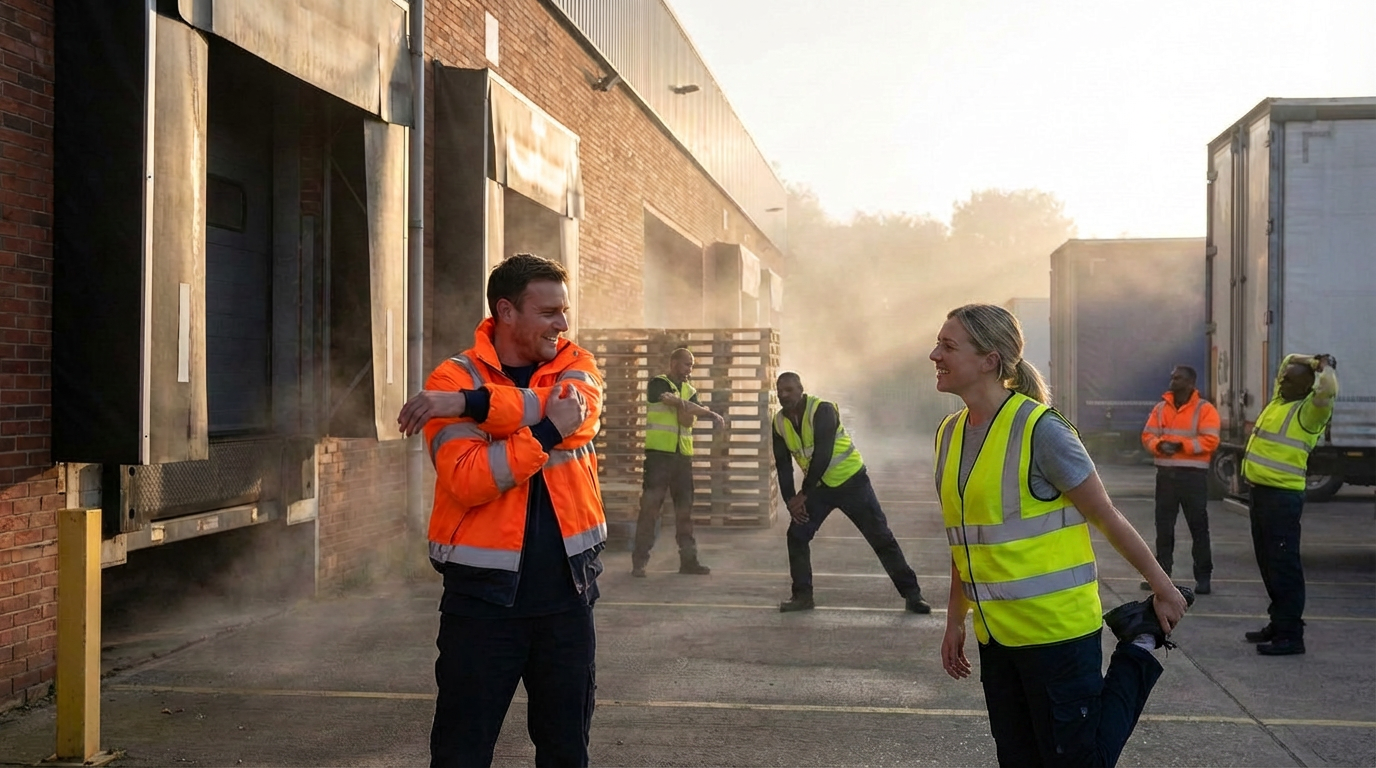
Active breaks in a logistics warehouse before the shift. The law does not require them, but they cut absenteeism by 18% to 25% depending on the operation.
Each obligation in the articles gives rise to 3 to 5 decisions the law does not spell out, and they separate the companies that comply from those that protect. That is what this series is about. Here are the three examples that come up most in our conversations with H&S specialists and HR leaders.
Art. 19 requires training «in sufficient and appropriate terms». The reality: training arrives as a PDF that gets signed reluctantly. What does change behaviour (on-the-job micro-sessions, drills with feedback, reinforcement from middle managers) appears in no official gazette. The 2026 reform strengthens job-specific prevention information, but the «how» is still up to you.
Art. 16 requires you to plan prevention. It does not tell you which leading indicators to monitor (near-misses reported, average time between safety observations, % of trained managers who give feedback). Without those indicators, you find out too late.
The line between common and occupational contingency is blurred, and the law does not settle it. That is where weeks of avoidable absence are lost: with a well-defined early return-to-work and job adaptation protocol, you recover up to 30% of those days. The reform extends the definition of work-related harm to mental, cognitive and emotional health: the line moves, but it does not disappear.
The upcoming episodes will unpack these gaps one by one. But first, it is worth measuring where you stand.
A summary of the most common questions about Ley 31/1995, the H&S obligations for companies, LISOS penalties, the reform approved in April 2026 and the link between regulatory compliance and reducing absenteeism.
Ley 31/1995 is Spain's Occupational Risk Prevention Act (LPRL), approved on 8 November 1995. It sets out the employer's obligations to guarantee workers' health and safety in all aspects related to work.
Yes. On 28 April 2026 the Council of Ministers approved a draft bill that amends, but does not replace, Ley 31/1995, together with the Estatuto de los Trabajadores and RD 39/1997. The law remains the framework regulation. The reform incorporates psychosocial and ergonomic risks and those arising from climate change, a gender and age perspective, and extends the definition of «work-related harm» to the mental, cognitive, behavioural, social and emotional spheres. It still has to go through Parliament before it comes into force.
Ley 31/1995 requires employers to assess occupational risks, plan prevention, train and inform workers, guarantee health surveillance, coordinate business activities with contractors and suppliers, and adopt emergency measures. All these obligations are developed in Real Decreto 39/1997 (Prevention Services Regulation).
Every company with at least one employee must comply with Ley 31/1995, whatever its size, sector or activity. It also applies to public administrations and to self-employed people with staff. The 2026 reform expressly extends its scope to self-employed workers coordinated with main contractors.
Breaches of the H&S Act can be minor, serious or very serious, with fines ranging from €45 up to €983,736 under the Ley sobre Infracciones y Sanciones en el Orden Social (LISOS, Spain's Social Order Infringements and Penalties Act). In addition, in the event of an accident, the employer may face civil and criminal liability and a surcharge on benefits. The 2026 reform also amends the LISOS to regulate infringements relating to equality and non-discrimination more precisely.
Not necessarily. Complying with Ley 31/1995 on paper does not guarantee accident prevention. According to Ministry of Labour data, 647,000 accidents with sick leave were recorded in 2024, mostly in companies whose H&S documentation was up to date. The difference between complying and protecting lies in how the plan is carried out day to day, which is exactly what this series addresses.
To get the most out of the series, it helps to know your starting point. We have built a free 3-minute self-assessment that evaluates your company across the four dimensions where real prevention is decided:
Answer 9 honest questions and we will email you your H&S maturity level (from reactive to preventive) and a concrete reading of the challenge at your level. No sales follow-up call: if you want to talk afterwards, it is your call.
Find out where your H&S plan is really leaking in 9 questions. We will send your occupational risk prevention maturity level and the specific challenge to tackle straight to your inbox.
Start self-assessmentA preview of the journey. Final titles may change based on what comes up in our conversations with you.
The paper mirage and the real cost of absenteeism.
What to do today with the newly approved draft bill: mental health, ergonomics and climate.
What works when statutory rest is not enough.
Real adjustments that don't require buying anything new.
What does show up in the accounts and nobody calculates.
The blurred line between common and occupational contingency.
The return to work the law leaves open.
Indicators that really tell you whether your plan is working.
We will email you new episodes so you don't miss a thing.
We will email you every time we publish a new episode of the series.
In the meantime, you can see the full roadmap of the 8 episodes.